
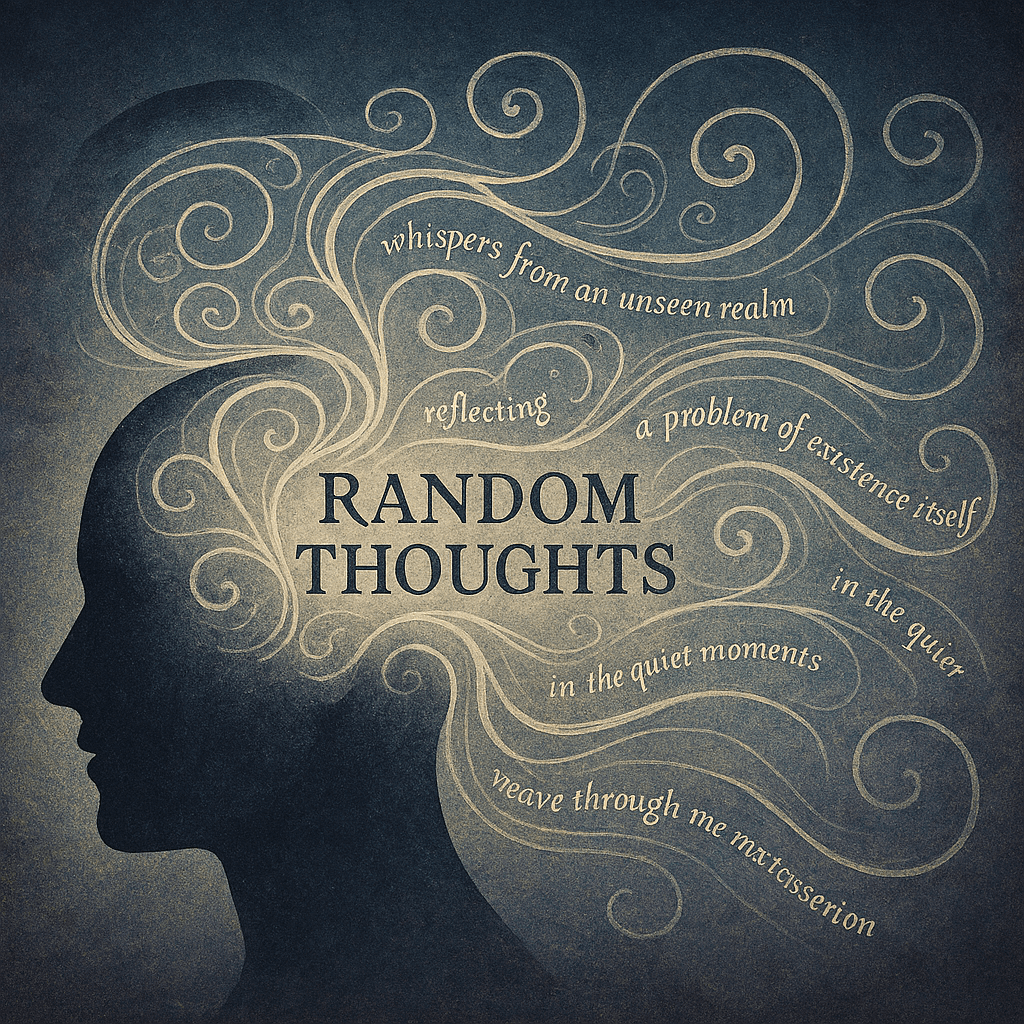

Random thoughts are like whispers from an unseen realm of our mind. They’re fleeting and often elusive. They come unbidden — at the turn of a page, in the middle of a conversation, or in the quiet moments before sleep claims us. These thoughts seem to have no rhyme or reason, yet they weave through the tapestry of our daily consciousness. They hint at the vast, uncharted territories of our inner world. They can be as mundane as remembering a forgotten item on a grocery list, or as profound as questioning the nature of existence itself.
The journey into the unpredictability of these thoughts is more than an exercise in introspection. It’s a voyage to the very edges of our understanding of the human mind. In these unguarded moments, our minds dance on the edges of creativity, innovation, problem-solving, and introspection. To explore these random musings is to embrace the mystery and complexity of thought itself — and to recognize the power that lies within the randomness.
As we embark on this exploration, we invite you to consider your own random thoughts differently. Rather than distractions or background noise, think of them as windows into the deeper, unexplored regions of your psyche. What might we discover about ourselves, our creativity, and our capacity for complex thought, if only we learn to listen to these whispers from within?
The Psychology Behind Random Thoughts
The human mind is an enigma. It’s capable of generating thoughts that range from the utterly mundane to the profoundly insightful. Psychologists have long been fascinated with the nature of random thoughts, seeking to understand their origins and the roles they play in our cognitive processes. These thoughts are often dismissed as mental clutter. In fact, they serve a much more complex and significant purpose in our overall psychological makeup.
Random thoughts can be seen as the mind’s way of sifting through information, memories, and experiences. Often, they make connections that aren’t immediately apparent to our conscious thought processes. This subconscious sorting and linking of ideas can lead to sudden insights or solutions to problems that have long eluded us. Our minds seem to work continuously in the background — processing and reevaluating information, even when we’re not actively focusing on a particular task.
The randomness of these thoughts is also a testament to the flexibility and adaptability of the human mind. Unlike computers, which process information in a linear and predictable manner, our brains thrive on the unpredictable, the abstract, and the novel. This ability to generate and entertain random thoughts is a crucial part of our creativity. It gives us a vast landscape of mental exploration and innovation.
The Role of Random Thoughts in Creativity
Creativity is that elusive spark that fuels art, innovation, and problem-solving. It’s deeply intertwined with the phenomenon of random thoughts. These spontaneous musings provide fertile ground for the seeds of creative ideas to germinate and grow. They let us make unique connections between seemingly unrelated concepts, leading to innovative solutions and groundbreaking ideas.
In the realm of creativity, randomness acts as a catalyst. It pushes the boundaries of conventional thinking and allows the mind to explore uncharted territories. When we let our thoughts wander without direction, we often stumble upon creative insights that would have stayed hidden had we stuck to linear thinking. It’s in the unexpected and the unpredictable that creativity often finds its most potent expressions.
Artists, scientists, and inventors alike have spoken of moments when a random thought led to a breakthrough in their work. These moments — often described as ‘eureka’ or ‘aha’ moments — underscore the importance of embracing the randomness within our minds. By creating an environment where random thoughts are actively encouraged, not just acknowledged, we can unlock the full potential of our creative capacities.
Embracing Randomness: Harnessing the Power of Random Thoughts
To truly harness the power of random thoughts, we must first learn to embrace their unpredictability. This means shifting our perspective — from viewing these thoughts as distractions, to recognizing them as valuable sources of insight and innovation. By welcoming randomness into our mental processes, we open ourselves to possibilities that rigid, linear thinking can’t provide.
One key strategy is to cultivate a mindset of openness and curiosity. Instead of dismissing random thoughts as irrelevant, we should explore them, probe their origins, and consider their potential implications. This exploratory approach can lead to surprising discoveries about our interests, passions, and problem-solving abilities.
Embracing randomness also means creating space in our lives for unstructured thinking. This could mean setting aside time for reflection, engaging in free-flowing conversations, or simply letting our minds wander without a specific goal in mind. It’s in these moments of unfettered thought that randomness can work its magic — sparking creativity and leading to unexpected solutions.
The Connection Between Random Thoughts and Problem-Solving
Random thoughts play a crucial role in problem-solving. They offer fresh perspectives and alternative approaches to challenges, breaking the mold of conventional thinking. When faced with a problem, our first instinct is often to apply tried-and-true methods. But it’s often the unexpected ideas — those random thoughts that seem to come from nowhere — that provide the most innovative solutions.
This connection is rooted in the mind’s ability to draw on a diverse array of memories, experiences, and knowledge, even those that seem unrelated to the task at hand. This mental cross-referencing can lead to the synthesis of new ideas, revealing solutions that linear analysis alone wouldn’t uncover.
Random thoughts can also serve as a mental reset. They offer a break from intense focus on a problem, which can prevent cognitive fatigue and let us return with renewed energy and a fresh perspective. Sometimes, stepping away and letting our minds wander is the most productive strategy of all.
The Science of Random Thoughts: Neurological Explanations
The generation of random thoughts isn’t just a psychological phenomenon — it’s a neurological one too. Recent advances in neuroscience have begun to shed light on how and why our brains produce these spontaneous musings. Using imaging technologies such as fMRI, researchers have observed activity in various parts of the brain when people report experiencing random thoughts.
One key area of interest is the default mode network (DMN) — a network of brain regions active when the mind is at rest and not focused on the external environment. The DMN is thought to be involved in self-referential thoughts, daydreaming, and the generation of random thoughts. Even when we’re not actively engaged in a task, our brains stay busy — processing experiences and generating ideas.
This neurological activity suggests that random thoughts are a natural, integral part of brain function. They serve various cognitive and psychological purposes — from facilitating creativity to aiding problem-solving — reflecting the brain’s incredible complexity and its capacity for abstract, non-linear thinking.
Techniques for Capturing and Organizing Random Thoughts
Given the potential value of random thoughts, it’s worth developing techniques to capture and organize them. One effective method is to carry a small notebook, or use a digital note-taking app, to jot down thoughts as they occur. This practice ensures that ideas are recorded for later reflection instead of lost to the ether.
Another technique is to schedule regular review sessions to sift through the thoughts you’ve collected. Categorize them, identify recurring themes, and evaluate their potential relevance to ongoing projects or problems. Organizing random thoughts this way not only prevents them from being forgotten — it also reveals connections and patterns that weren’t initially apparent.
Mind mapping is also a valuable tool here. By visually mapping out random thoughts and their potential relationships, we can uncover novel solutions and ideas that a more linear approach might miss. Mind maps give us a flexible framework for exploring the complexity and interconnectedness of our thoughts, helping us understand how they relate to our creative and problem-solving efforts.
Embracing the Unpredictability: Embracing the Beauty of Random Thoughts
To truly appreciate the value of random thoughts, we must learn to embrace their inherent unpredictability. This unpredictability isn’t a flaw — it’s a feature. It’s a testament to the dynamic, expansive nature of human thought. Our minds aren’t confined to linear paths. They’re capable of wandering into uncharted territories, discovering new ideas and solutions along the way.
Embracing the unpredictability of random thoughts means recognizing their role in the creative process, in problem-solving, and in our personal growth. It means letting go of the need for control and certainty, and allowing our thoughts to flow freely without judgment. In doing so, we open ourselves to a world of possibilities — to insights and innovations we could never have anticipated.
The beauty of random thoughts lies in their ability to surprise and inspire us, to challenge our assumptions, and to push us beyond our comfort zones. They remind us of the vast, untapped potential within our minds, waiting to be explored and harnessed. By embracing the unpredictability of these thoughts, we embrace the full spectrum of our cognitive and creative abilities.
Sharing and Discussing Random Thoughts in Online Communities
In the digital age, online communities have become vibrant spaces for sharing and discussing random thoughts. Platforms such as forums, social media, and dedicated apps let people share their spontaneous musings with a wider audience. These communities offer a sense of connection and validation, as members discover that their random thoughts are not only common, but valued by others.
Engaging in discussions about random thoughts can lead to fascinating conversations, sparking creativity and collaboration. It’s a process of collective exploration, where ideas are built upon, challenged, and refined. These interactions can lead to new friendships, professional connections, and even collaborative projects.
Online communities also offer a diverse range of perspectives, enriching the discussion and expanding our understanding of what our thoughts might mean. They remind us that our random musings — no matter how trivial they may seem — can resonate with others and contribute to a larger dialogue. Sharing and discussing our random thoughts in these spaces can be deeply rewarding, fostering a sense of belonging and mutual inspiration.
Conclusion: Embracing the Mysterious Musings of the Mind
The journey into the unpredictability of random thoughts is a testament to the complexity and wonder of the human mind. From the psychology behind their occurrence to their role in creativity and problem-solving, these spontaneous musings offer real insight into our cognitive processes. By embracing the unpredictability and harnessing the power of random thoughts, we unlock a world of possibilities — fostering innovation and personal growth.
As we conclude this exploration, let’s carry forward an appreciation for the mysterious musings of our minds. Let’s create spaces, both within ourselves and in our communities, where random thoughts are not only accepted, but celebrated. In doing so, we embrace the full spectrum of our mental and creative capacities, embarking on a journey of discovery that knows no bounds.
In the spirit of embracing the unpredictable, let’s continue to share, discuss, and marvel at the random thoughts that arise. They are the seeds from which the flowers of creativity and insight bloom. Together, let’s journey into the mysterious musings of the mind, embracing each thought as a step on the path to deeper understanding and boundless imagination.


