
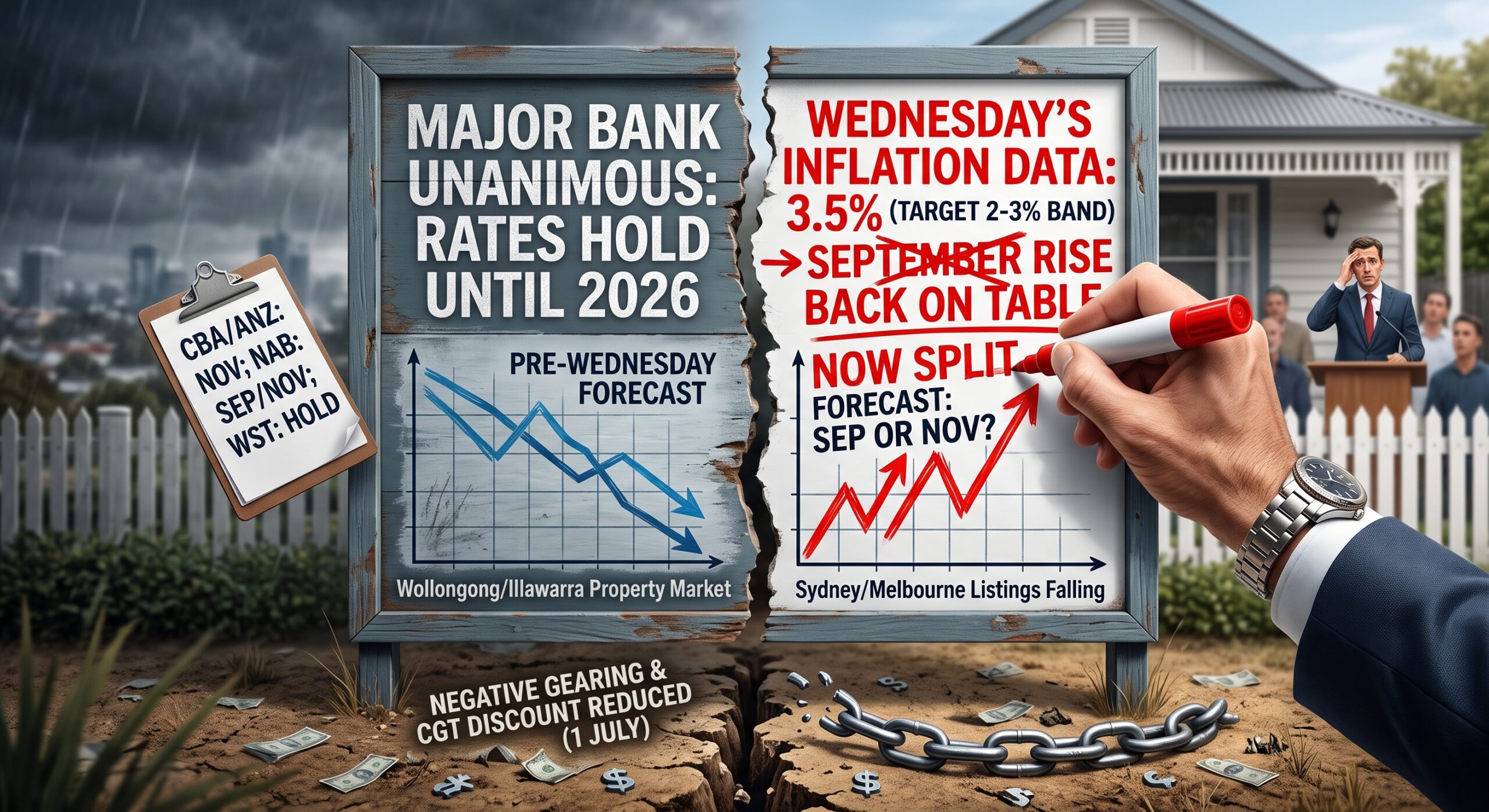
Three weeks ago, all four major banks were unanimous: rates would hold for the rest of 2026. That consensus didn’t survive contact with Wednesday’s inflation data. A hotter-than-expected result has put a September rate rise back on the table, and the spring property market is about to feel it.
What Actually Changed
Annual headline inflation came in at 3.5% for the 12 months to July — above the 3.2-3.3% economists expected, and still well outside the RBA’s 2-3% target band. That’s enough to have shifted the conversation from “will there be another hike” to “will it come in September or November.”
The banks are now split. CBA and ANZ are backing a November move. NAB’s chief economist expects September, with a possible second hike in November on top. Westpac remains the outlier, still betting on a hold for the rest of the year. AMP Capital’s Shane Oliver, who was confident a hike wouldn’t land until November, now says the Reserve Bank board could move as early as its next meeting.
Investors Have Already Left the Building
Rate uncertainty isn’t the only thing keeping investors on the sidelines. From 1 July, negative gearing was abolished on existing investment properties and the 50% capital gains tax discount was cut for properties held over a year — changes that landed alongside three rate hikes and have genuinely reshaped the after-tax return on established property. New home loan numbers fell 5.4% in the June quarter, driven almost entirely by an 8.6% drop in investor lending.
AMP’s Shane Oliver doesn’t expect investors back until rental yields rise meaningfully — prices haven’t fallen far enough yet to offset the lower after-tax return the tax changes created. He also points to a supply-side wrinkle: falling listings in Sydney and Melbourne have been propping up prices so far, but it’s really a demand problem in disguise, and it’s an open question whether that stock reappears once spring arrives.
Not everyone reads the retreat as bad news. Propertybuyer’s Rich Harvey argues the reduced competition is exactly why now could be a good entry point — auction turnout has thinned noticeably, and he sees investors gradually shifting toward higher-yield property types like duplexes, rooming houses, and co-living setups that are easier to hold through a slower growth period, even if they’re not always the strongest pick for capital growth.
Why This Hits Right When It Hurts Most
Spring is normally when the property market wakes up — more listings, more buyers, more confidence. Instead, buyers and sellers who’d spent months trying to read the market are back to square one. Domain’s chief economist Nicola Powell put it plainly: buyers looking for a reason to delay their decision now have one.
Buyers move first and fastest when uncertainty shows up, and that’s exactly what’s happening. Sellers face the flip side of the same problem — deciding whether to list into a market where confidence just took a hit, or hold off and hope for clearer signals later. One Sydney agent’s take cuts through some of the seasonal mythology here: buyers don’t really buy by the calendar, they buy when their own circumstances line up — job security, confidence, a genuine need to move.

Where Prices Actually Go From Here
Some economists are now tipping capital city prices to fall 7-8% from their peak before the market bottoms out — with that bottom not expected until the June quarter of next year. Rate cuts aren’t expected until the second half of next year at the earliest, once inflation is genuinely back under control.
There’s a genuine silver lining buried in the gloom, though. Lending figures for first-home buyers have actually risen, and so has investor lending for new-build property — it’s lending against established homes that’s pulled back. If you’re a first-home buyer, a softer market with less investor competition for existing homes is not nothing.
What This Means If You’re Buying or Selling Right Now
If you’re mid-negotiation or about to list, the practical takeaway isn’t to panic — it’s to stop waiting for certainty that isn’t coming. The rate decision lands September 29, and even that won’t fully settle things; NAB and CBA already see a chance of a second hike in November regardless of what happens in September.
For buyers, that means locking in your borrowing capacity and getting genuinely pre-approved rather than assuming today’s numbers will still apply in three months. It’s also worth checking what lenders are actually doing to compete for first-home buyer business right now — some banks have quietly introduced more lenient policies, like allowing notional rent from a spare bedroom to count toward income, or excluding HECS repayments from serviceability calculations if the debt would clear within the loan’s first year. For sellers, it means being realistic about where buyer appetite actually sits right now, not where it sat back when everyone thought rates were done moving for the year.
Related Reading
- Why Rates Rose When Everyone Expected Cuts (And What Borrowers Should Do Now)
- RBA News: Banks Launch Rate War After Surprise July Hold
- Finance Strategies for Australians
Sources: Domain, “September rate hike fears add to uncertainty for home buyers and sellers,” August 28, 2026; realestate.com.au, “Spring shake-up: What to expect from property investors.”
