
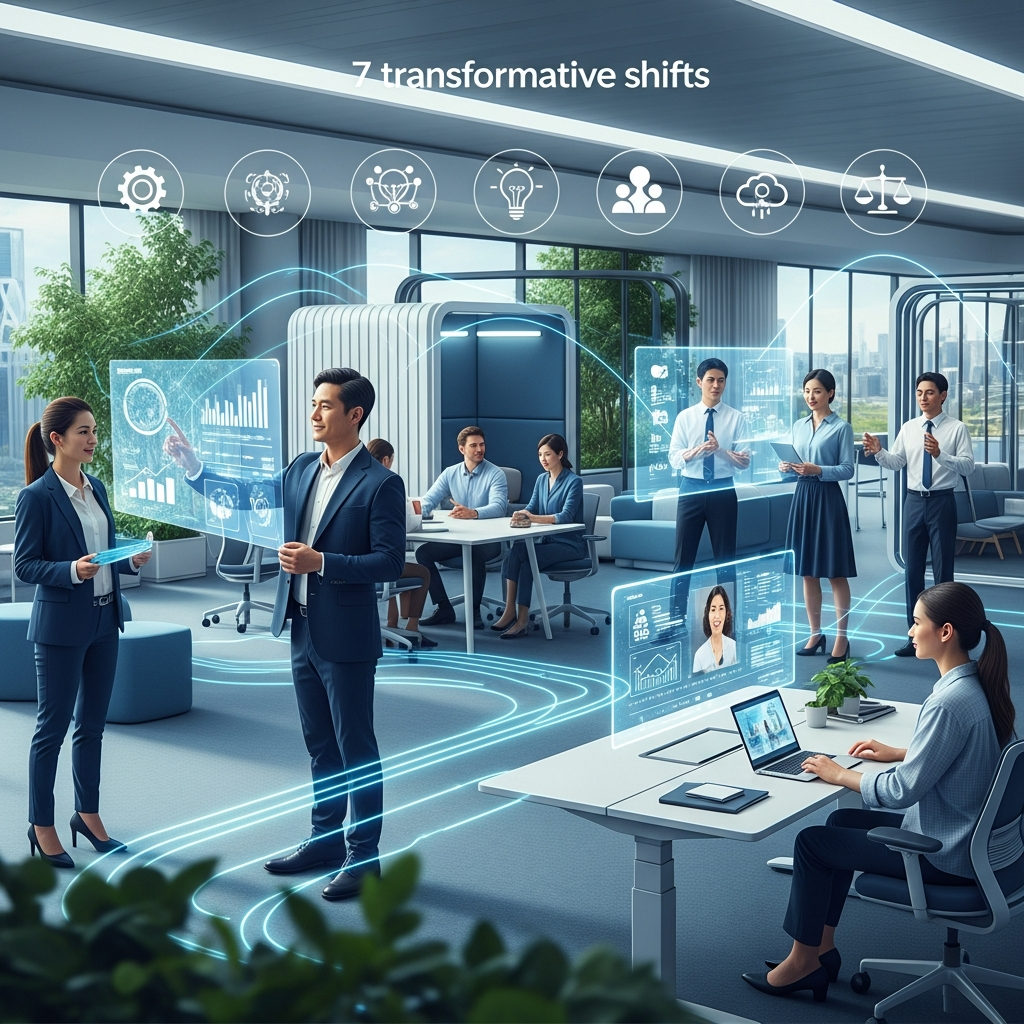
Workplace trends: 7 transformative shifts for an effortless professional future are redefining how we perceive productivity, balance, and the very nature of a “career.” As the traditional 9-to-5 model fades into history, organizations and employees alike are pivoting toward structures that prioritize autonomy, digital fluidity, and human-centric design. We are no longer merely adapting to technology; we are building an ecosystem where professional life feels intuitive rather than mechanical.
Here are seven transformative shifts that are clearing the path toward an effortless professional future.
1. From Rigid Schedules to Asynchronous Excellence
The era of mandatory synchronous presence is ending. In the past, productivity was measured by the amount of time spent at a desk. Today, high-performing teams are shifting toward asynchronous workflows. This model acknowledges that employees have different energy peaks and personal obligations. By relying on robust documentation and collaborative platforms rather than back-to-back Zoom calls, organizations allow talent to contribute when they are most focused, leading to higher quality work and less burnout.
2. Radical Transparency and Data-Driven Culture
Information hoarding is a hallmark of an inefficient workplace. The modern shift involves “open-by-default” communication. When companies use shared digital dashboards and transparent project management tools, the need for constant status update meetings disappears. Employees can self-serve the information they need, empowering them to make decisions faster. When everyone has access to the same “source of truth,” the friction caused by miscommunication is practically eliminated.
3. The Rise of the “Human-Centric” Office
The physical office has been reimagined not as a place for individual work, but as a “collaboration hub.” Because deep, focused work can be done from anywhere, the office is becoming a space for social connection, brainstorming, and complex problem-solving. This shift removes the “effort” of commuting for tasks that don’t require it, while ensuring that when team members do meet in person, it is purposeful, intentional, and high-impact.
4. Integrating AI as a Cognitive Partner
Artificial Intelligence is no longer just a tool for automation; it is becoming a silent partner in the professional workflow. Whether it is using AI for real-time translation, complex data synthesis, or drafting correspondence, the goal is to offload “cognitive drudgery.” By delegating repetitive tasks to machines, professionals are free to focus on the truly creative and strategic elements of their roles. This partnership makes complex tasks feel significantly lighter and more manageable.
5. Skills-Based Hiring Over Degree-Based Credentials
The future is moving toward a meritocracy of skills. Companies are realizing that the rate of technological change makes static academic degrees less relevant than an individual’s ability to learn and adapt. By focusing on skill sets, recruiters can identify candidates who can hit the ground running. For employees, this removes the pressure of the “career ladder” and replaces it with a “career portfolio,” where you are judged by what you can do today rather than where you studied a decade ago.
6. Prioritizing Holistic Wellbeing as a KPI
In an effortless future, wellbeing is not an HR perk—it is a core business KPI. Burnout is the antithesis of professional efficiency. Forward-thinking companies are recognizing that mental health days, flexible boundaries, and wellness stipends lead to greater longevity and output. When an employee feels supported, they bring their best self to the task. This shift creates a sustainable loop of performance where the “hustle culture” is replaced by a culture of recovery and sustained energy.
7. Globalized Talent Networks and Fractal Teams
Geographic boundaries are being erased by decentralized talent pools. Organizations are increasingly building “fractal teams”—small, autonomous groups of experts located anywhere in the world, brought together for specific projects. This eliminates the effort of trying to find the “best person available within 20 miles” and allows teams to recruit the “best person for the role, period.” This fluid approach to staffing makes project mobilization faster and innovation more diverse.
The Path Forward
The journey toward an effortless professional future isn’t about doing less; it is about removing the friction that stands between talent and results. By embracing these seven shifts, we move away from the bureaucracy and exhaustion that defined the industrial age and into a new era where work is characterized by flow, autonomy, and purpose.
As we continue to integrate these trends, the most successful professionals will be those who remain agile, keep an open mind toward new technologies, and prioritize the human elements that machines can never replicate. The future of work is not just coming; it is already here for those willing to adapt.


